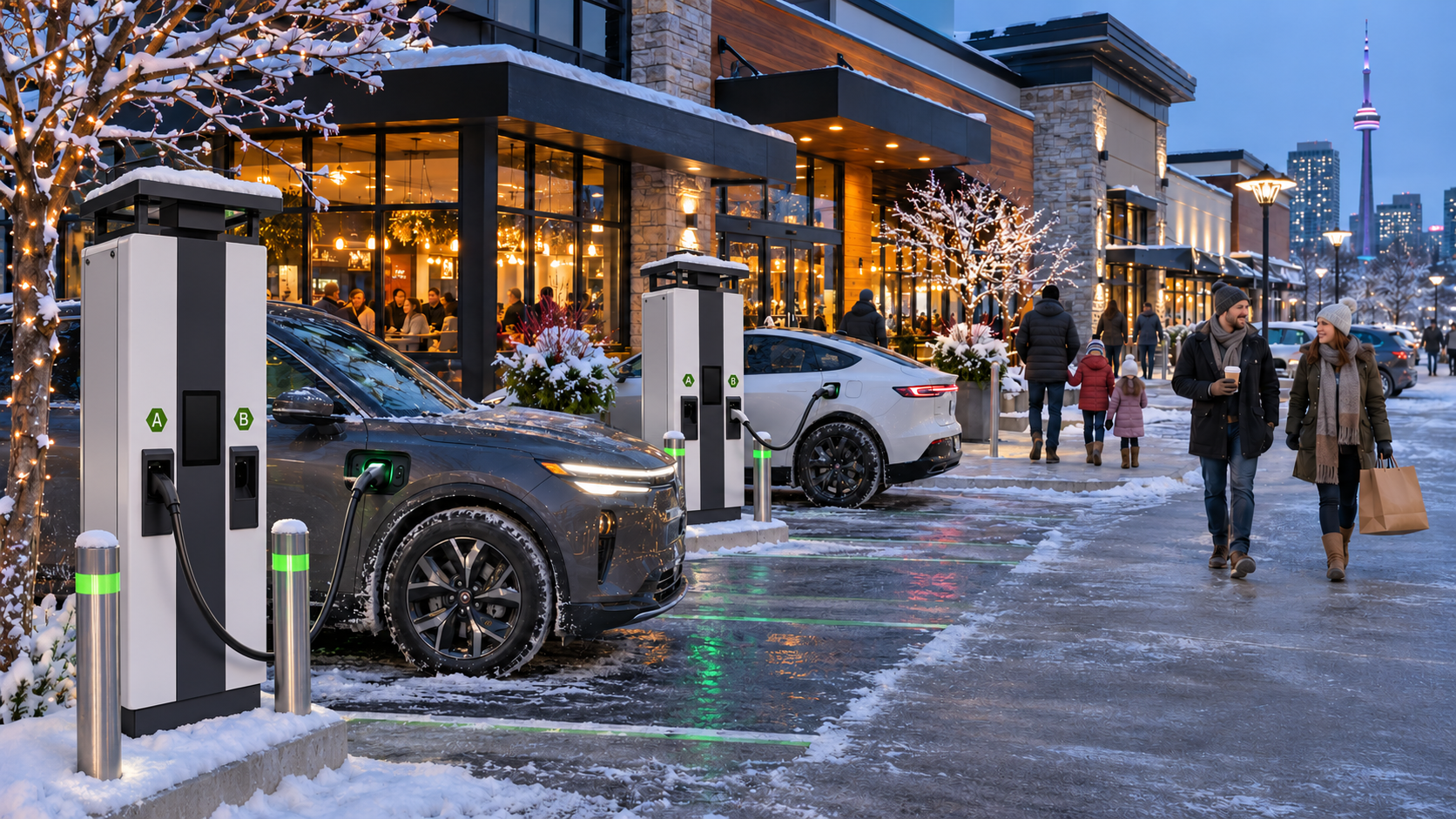
Can Your EV Charging Station Handle a Canadian Winter? Why Cold Weather Creates New Opportunities for Businesses
Can Your EV Charging Station Handle a Canadian W
inter? Why Cold Weather Creates New Opportunities for Businesses
How shopping centres, hotels, restaurants, and commercial property owners can turn winter EV charging needs into customer traffic and new revenue opportunities.
What if Canada's coldest months could bring new customers to your business?
Every winter, millions of Canadians deal with freezing temperatures, snow-covered roads, and higher energy consumption. For electric vehicle (EV) drivers, cold weather brings another challenge: reduced driving range and potentially slower charging.
But for business owners with parking spaces, this challenge presents an interesting opportunity.
As EV drivers look for convenient places to recharge, retail businesses, shopping centres, hotels, restaurants, and other commercial properties can become attractive charging destinations.
The question is no longer just whether your business needs EV chargers. It's whether your property could benefit from becoming an EV charging destination.
1. The Canadian Winter EV Challenge: What the Numbers Tell Us
Cold weather affects electric vehicles in several ways.
Batteries operate less efficiently at low temperatures, cabin heating consumes energy, and charging speeds can decrease when batteries are cold.
The Canadian Automobile Association (CAA) conducted a real-world winter EV performance test in February 2025, driving electric vehicles between Ottawa and Mont-Tremblant in temperatures ranging from approximately −7°C to −15°C.
The findings were significant:
EVs travelled 14% to 39% less than their officially rated driving range.
More than 65% of surveyed Canadian EV owners reported experiencing reduced driving range in extreme cold.
Four in ten EV owners surveyed identified significantly slower charging in extreme cold as a problem.
Source: Canadian Automobile Association — Winter EV Performance Test
What does this mean in everyday driving?
Imagine an electric vehicle with an official range of 400 kilometres.
Under conditions that reduce its range by 30%, its available driving range could fall to approximately 280 kilometres.
That's 120 fewer kilometres before the vehicle needs to recharge.
For a driver travelling between Edmonton and Calgary, making deliveries around Toronto, or visiting multiple customers across Greater Vancouver, this difference can influence where and when they stop to charge.
Although many EV owners charge at home, drivers on longer journeys, residents without dedicated home charging, and customers who spend extended periods away from home may benefit from more accessible public charging.
For businesses, providing convenient EV charging can make your property an attractive place to stop.
2. Canada's EV Market Is Growing — And So Is the Need for Convenient Charging
EV charging is not simply a future trend. Electric vehicles are already becoming part of everyday transportation across Canada.
According to Statistics Canada:
Canada recorded 58,811 new zero-emission vehicle registrations in Q2 2026.
In 2025, zero-emission vehicles represented 3.5% of Canada's registered light-duty vehicle fleet, up from 2.0% in 2023.
Approximately 8.7% of new vehicles sold in Canada in 2025 were zero-emission vehicles.
These figures include both battery-electric and plug-in hybrid electric vehicles.
Source: Statistics Canada — A Pan-Canadian Electric Feel, September 2026
As the number of EVs on Canadian roads increases, businesses have an opportunity to serve customers who prefer convenient charging during their normal daily activities.
Instead of making a special trip to charge, drivers may prefer locations where they can shop, eat, work, or relax while their vehicles are plugged in.
That creates an opportunity for commercial property owners to offer an additional service without changing their core business.
3. EV Charging Can Attract Customers — And Research Supports the Opportunity
Imagine two shopping plazas located only a few kilometres apart.
Both have similar stores, restaurants, and parking facilities.
However, one has publicly accessible EV charging stations, while the other doesn't.
An EV driver who needs to recharge may have an additional reason to choose the plaza with charging.
Once parked, that customer could visit a coffee shop, buy groceries, or enjoy a meal.
This isn't just a hypothetical business concept.
Research: EV charging stations can increase nearby business spending
A 2024 study by researchers affiliated with MIT, published in Nature Communications, analyzed more than 4,000 EV charging stations and 140,000 nearby businesses in California.
Researchers found that opening charging stations was associated with average annual spending increases at nearby businesses of:
1.4% in 2019
0.8% during the 2021–2023 study period
The benefits were particularly noticeable among businesses located close to charging stations.
Source: MIT News — EV Charging Stations Boost Nearby Business Spending
These findings do not guarantee equivalent results for Canadian properties. However, they demonstrate that EV charging infrastructure can create economic benefits beyond the revenue collected from electricity sales.
For commercial property owners, EV charging may represent two opportunities: direct charging revenue and additional customer spending.
4. The Customer Experience: Turn Charging Time Into Shopping Time
One of the biggest differences between traditional refuelling and EV charging is how customers spend their time.
At a gas station, customers may refuel and leave within minutes.
With EV charging, drivers often spend longer at the location, depending on charger speed, vehicle capability, and how much energy they need.
This creates opportunities for businesses to provide services while drivers charge.
Example A: A shopping centre in Toronto
An EV driver visits a shopping centre on a cold Saturday afternoon.
Instead of parking in a regular space, they choose an available Level 2 EV charger.
While the car charges, the driver:
Buys groceries
Visits a retail store
Stops for coffee
The driver benefits from convenient charging, while the shopping centre gains another reason for customers to choose its location.
Example B: A restaurant in Edmonton
A family travelling through Edmonton needs to stop for lunch and recharge their electric vehicle.
They find a restaurant offering convenient EV charging.
Rather than visiting one location to charge and another to eat, they can do both at the same place.
The restaurant benefits from the opportunity to attract a customer who might otherwise have stopped somewhere else.
Example C: A hotel in Vancouver
A business traveller arrives at a hotel in an electric vehicle.
The hotel offers overnight Level 2 EV charging.
Instead of searching for a public charging station before the next day's meetings, the guest can charge while sleeping.
Convenient EV charging becomes an additional hotel amenity that may influence booking decisions and improve guest satisfaction.
These examples illustrate potential customer behaviour, not guaranteed business outcomes.
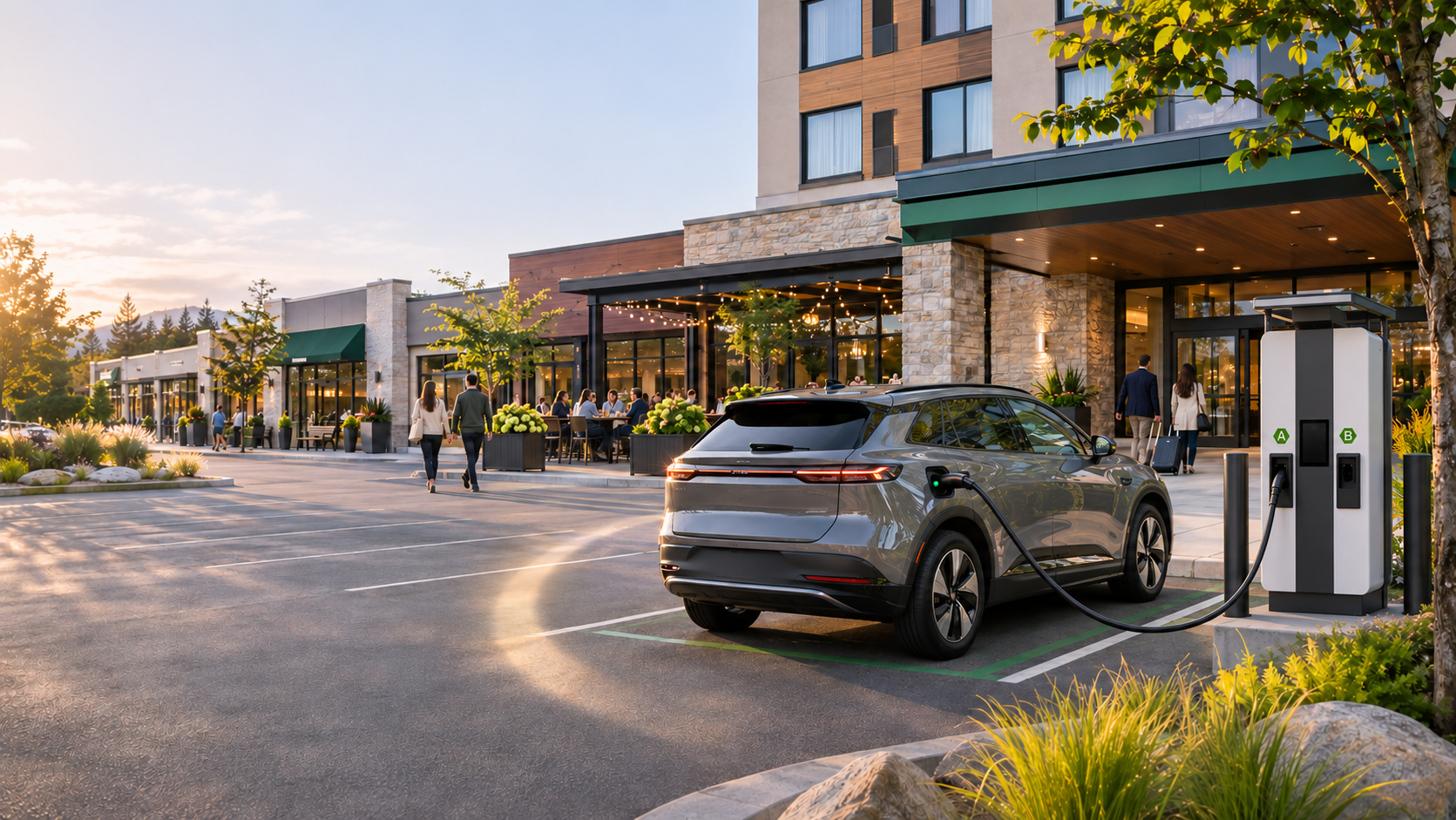
5. Level 2 or DC Fast Charging: Which EV Charger Is Right for Your Business?
Not every commercial property needs the same type of EV charger.
Choosing the right charging solution depends on customer parking duration, electrical capacity, installation costs, expected usage, and business objectives.
Property type | Potential charging solution | Why it may fit |
|---|---|---|
Restaurants and cafés | Level 2 or DC fast charging | Customers may charge during meals |
Shopping centres and retail plazas | Level 2 and DC fast charging | Supports both extended visits and quicker stops |
Hotels and resorts | Level 2 | Well suited to overnight parking |
Offices and workplaces | Level 2 | Employees park for several hours |
Grocery stores | Level 2 or DC fast charging | Supports shopping visits of varying lengths |
Gas stations and highway stops | DC fast charging | Suited to drivers seeking a faster recharge |
Condominiums and apartments | Level 2 | Supports regular residential charging |
A Level 2 charger is often a practical choice when vehicles remain parked for several hours.
DC fast charging is generally better suited to locations where drivers need to add substantial energy in a shorter period.
Actual charging time depends on the vehicle, battery temperature, state of charge, and charger capacity.
The best solution is not necessarily the fastest or most expensive charger. It's the charging system that matches how people use your property.
6. Can Your Commercial EV Charger Survive a Canadian Winter?
When installing EV charging infrastructure in Canada, equipment selection matters.
Winter conditions in Edmonton, Calgary, Toronto, and many other Canadian cities can include freezing temperatures, snow, road salt, ice, and repeated freeze-thaw cycles.
A reliable commercial EV charging installation should consider more than the advertised power rating of the charger.
Important considerations include:
Cold-weather operating specifications
Verify that the charger is rated for the expected site temperatures. Storage temperature and operating temperature ratings are not necessarily the same.
Suitable outdoor equipment
Select appropriate outdoor-rated enclosures, cables, connectors, and mounting systems that can withstand the intended conditions.
Electrical installation and protection
Electrical distribution, grounding, protection devices, and installation methods must meet applicable Canadian electrical requirements and local permitting rules.
Convenient year-round access
Charging spaces should remain accessible during snow removal operations, with thoughtful placement of charging cables and equipment.
Reliable network connectivity and support
A working EV charger also depends on payment systems, communications, monitoring, and timely technical support.
A poorly planned charging station can frustrate customers and create maintenance expenses.
Working with an experienced EV charging contractor helps property owners evaluate these factors before investing.
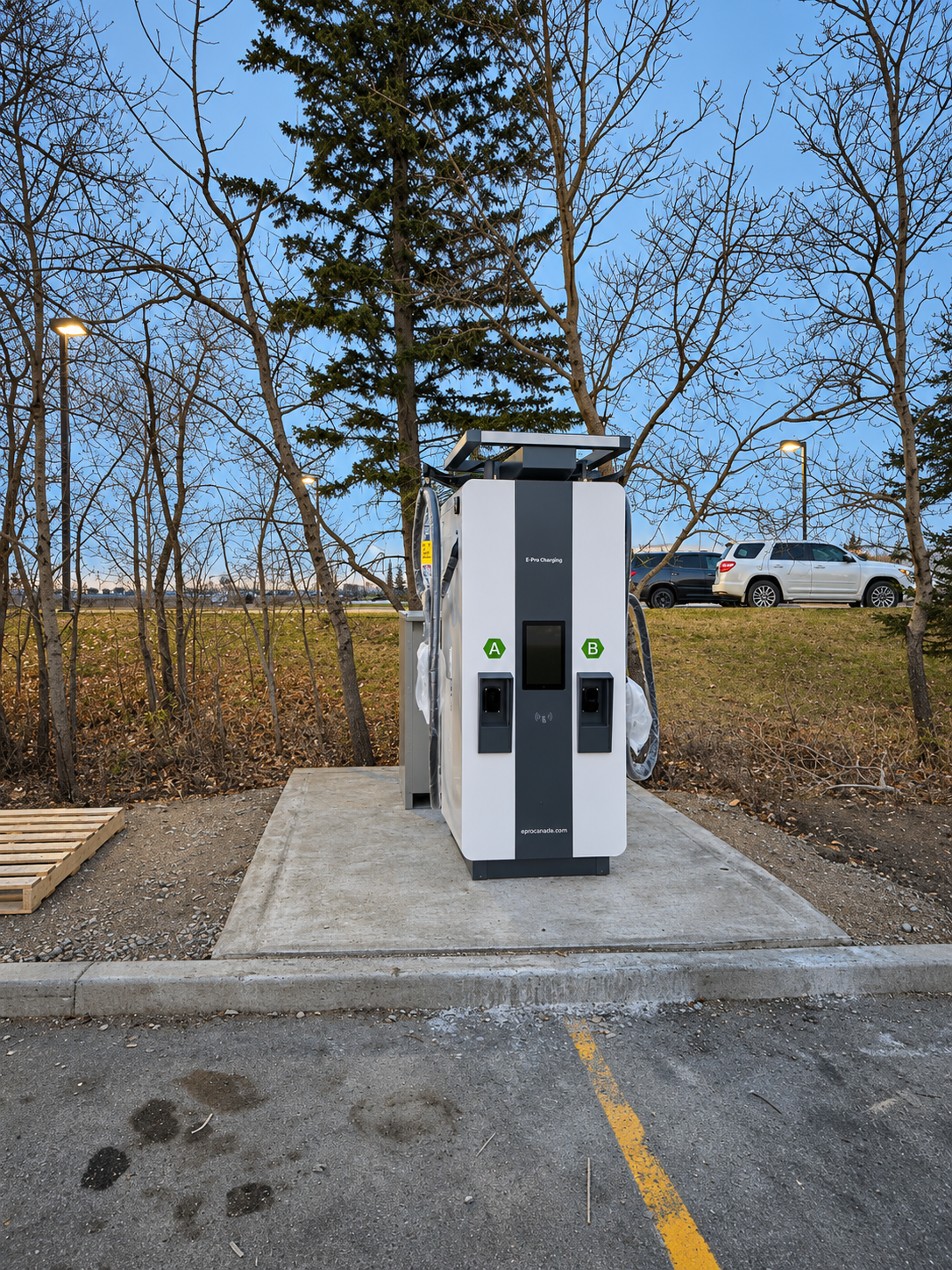
7. How Can Businesses Generate Revenue From EV Charging?
Commercial EV charging can provide several potential financial benefits.
Opportunity 1: Charging revenue
Businesses may collect fees for the electricity and charging services they provide, depending on their operating arrangement.
Revenue depends on charging utilization, pricing, electricity costs, network fees, and other operating expenses.
Opportunity 2: Additional customer visits
EV drivers may discover a business through charging maps or select a location because charging is available.
This creates opportunities for new customers to visit the property.
Opportunity 3: Customer experience and retention
A hotel guest, restaurant customer, or office tenant with an electric vehicle may appreciate access to charging as part of the property's amenities.
Opportunity 4: Long-term property competitiveness
As EV adoption changes parking expectations, charging infrastructure may help commercial properties remain attractive to certain tenants and customers.
Any potential effect on property value depends on location, infrastructure quality, tenant demand, and the broader real estate market.
8. What If Your Business Could Install EV Chargers Without a Large Upfront Investment?
For some commercial property owners, the biggest concern is not whether EV charging is useful.
It's the installation cost.
New electrical infrastructure, equipment, civil work, permits, and network services can make commercial EV charging projects expensive.
This is why E-Pro Canada offers a Commercial EV Charging Program designed to help eligible property owners explore EV charging without a substantial upfront capital commitment.
Depending on property eligibility and the approved project structure, the program may include:
EV charging equipment
Installation support
Network services
Charging revenue-sharing opportunities
Ongoing operational arrangements
Certain qualifying projects may be structured with no upfront equipment or installation payment by the host, subject to the program's lease arrangements, site requirements, and contractual terms.
The objective is simple:
Help businesses make better use of their parking facilities while providing convenient charging infrastructure for Canadian EV drivers.
Program eligibility, financial responsibilities, maintenance obligations, and revenue-sharing terms are evaluated for each property.
9. Looking for a Reliable EV Charging Contractor in Canada?
Whether you own a retail plaza in Toronto, operate a restaurant in Edmonton, manage a hotel in Vancouver, or develop commercial properties in Calgary, choosing the right EV charging supplier and contractor is an important decision.
E-Pro Canada provides commercial EV charging solutions for businesses and property owners across multiple Canadian markets.
Our approach focuses on evaluating each site's charging needs, electrical infrastructure, installation requirements, and potential long-term business opportunities.
We work with commercial property owners exploring solutions for:
Retail businesses and shopping centres
Restaurants and hospitality properties
Offices and workplaces
Hotels and resorts
Gas stations and commercial parking facilities
Condominiums and multi-unit residential buildings
For businesses seeking an EV charging contractor in Ontario, an EV charging provider in Toronto, a commercial EV charging contractor in BC or Vancouver, or an EV charging supplier and contractor in Alberta, Edmonton, or Calgary, E-Pro Canada can discuss potential project solutions.
From equipment selection and installation planning to charging-network arrangements and revenue-sharing options, we aim to help property owners build practical EV charging infrastructure.
10. Is Your Parking Lot Ready to Become an EV Charging Destination?
Canadian winter brings challenges for electric vehicle drivers.
But it also creates opportunities for businesses that can provide convenient, dependable charging.
With more electric vehicles on the road, commercial parking spaces can serve a greater purpose than simply accommodating parked cars.
They can become part of Canada's expanding EV charging infrastructure.
For property owners, the opportunity is worth exploring:
More convenient charging. More reasons for customers to visit. More potential revenue opportunities.
Join E-Pro Canada's Commercial EV Charging Program
Do you operate a shopping centre, restaurant, hotel, grocery store, office building, or other commercial property with customer parking?
Discover whether your location qualifies for E-Pro Canada's Commercial EV Charging Program.
Contact E-Pro Canada for a commercial EV charging site assessment.
Phone: +1-855-501-0111
E-Pro Canada
Power Your Property. Create New Opportunities.
Program availability, installation scope, funding structure, and revenue-sharing terms are subject to eligibility, site assessment, and executed agreements.
